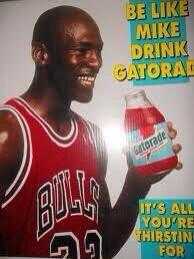
Many athletes, both professional and amateur, rely on the effectiveness of Gatorade, I considered myself one. Before every game I would rush to get my lemon-lime Gatorade, scoff at Powerade and decline basic water. Gatorade was distinctly different and superior to those alternatives. Gatorade was what Michael Jordan had, it was what every athlete had. As its commercial said, Gatorade was created in a University of Miami laboratory to optimize the ability of athletes. Even when athletes were drinking water, they drank it out of Gatorade cups. I bought into the branding. For a two years in middle school and two in high school, me and my teammates flooded our bodies with Gatorade It turns out, Gatorade is actually less refreshing and replenishing than water. Gatorade exemplifies Einstein's idea that “branding is about... taking the individual aspects of a product and turning them into more than the sum of their parts.” Gatorade was and is simply water, sugar and artificial flavor, no different than any ordinary juice. Reflecting on it, my comfort in Gatorade was no different than Mike's Special Stuff in Space Jam; simply mentally replenishing. Sure it was nothing, but belief in it was good enough. Despite its simplicity, Gatorade was double the price and double the authenticity.
By students in Religious Studies 150, "Pop Culture/Pop Religion," Hamilton College. Autumn term, 2014
Showing posts with label Mara Einstein. Show all posts
Thursday, December 11, 2014
Mike's Special Stuff
In Generation Like, the importance and influence of branding is highlighted, however, the movie overstates its transformation. Branding has existed for centuries and fundamentally impacts the perception, motives, and identity of the average person. As Mara Einstein suggests, brands are pieces of our identity. Branding reflects a religious devotion and faith in companies. As in religion, branding lauds the importance of seemingly insignificant and malleable notions. These seemingly arbitrary distinctions of sacred and ordinary, confuse many who are not personally engaged. For example, the act of celebrating Easter may confound and confuse many atheists. Branding behaves in a similar way.

Labels:
Gatorade,
Mara Einstein,
Michael Jordan,
Space JAm
Branding and our Identity
Branding Religion
Religion and marketing share a chief interest; proposing a "product" that is meaningful and valuable to a mass of people. Religion is associated to a variety of intended "products" disguised as faith, values, and guidelines that offer individuals meaning, purpose, and order to their worlds.
In The Language of Clothes, Alison Lurie provides a literal example of clothes and jewelry as products in religion that both help project one's religious identity and symbol larger aims of their perspective beliefs. Thus, a cross on a chain becomes more than a piece of metal to a Christian; it becomes a representation of Jesus Christ, of sacrifice, and of faith. Similarly, in her piece Branding Faith, Mara Einstein articulates the function of branding in marketing: "branding is about making meaning--taking the individual aspects of a product and turning them into more than the sum of their parts." She illustrates that consumers are taken by products because of the ideas they represent, whether that becomes a symbol of social status, wealth, or reputation. This becomes most apparent in commercials for products where the message becomes very far-fetched from the actual product. In a 2014 Super Bowl commercial titled "Puppy Love", Budweiser promotes its drink by illustrating an unbreakable bond of friendship between a puppy and the animals/people on a farm, ending with the pun-y hashtag, #bestbuds. By appealing to the deep meaning of friendship, and the undeniable cuteness of the puppy, the company is able to attract a vast array of consumers, uniting them under the feeling invoked by the commercial. Frontline's documentary, Generation Like promotes the same idea, where marketers analyze consumers' interests and friends through things like Facebook to gage future consumers and open their markets to different communities.
Religion functions very similarly. Although these religious "products" don't have to be tangible, they can "sell" someone like Jesus Christ or something like the idea of salvation to different consumers by applying deeper meaning and purpose to these products.
In The Language of Clothes, Alison Lurie provides a literal example of clothes and jewelry as products in religion that both help project one's religious identity and symbol larger aims of their perspective beliefs. Thus, a cross on a chain becomes more than a piece of metal to a Christian; it becomes a representation of Jesus Christ, of sacrifice, and of faith. Similarly, in her piece Branding Faith, Mara Einstein articulates the function of branding in marketing: "branding is about making meaning--taking the individual aspects of a product and turning them into more than the sum of their parts." She illustrates that consumers are taken by products because of the ideas they represent, whether that becomes a symbol of social status, wealth, or reputation. This becomes most apparent in commercials for products where the message becomes very far-fetched from the actual product. In a 2014 Super Bowl commercial titled "Puppy Love", Budweiser promotes its drink by illustrating an unbreakable bond of friendship between a puppy and the animals/people on a farm, ending with the pun-y hashtag, #bestbuds. By appealing to the deep meaning of friendship, and the undeniable cuteness of the puppy, the company is able to attract a vast array of consumers, uniting them under the feeling invoked by the commercial. Frontline's documentary, Generation Like promotes the same idea, where marketers analyze consumers' interests and friends through things like Facebook to gage future consumers and open their markets to different communities.Religion functions very similarly. Although these religious "products" don't have to be tangible, they can "sell" someone like Jesus Christ or something like the idea of salvation to different consumers by applying deeper meaning and purpose to these products.
Subscribe to:
Posts (Atom)