Showing posts with label The Hunger Games. Show all posts

Thursday, December 11, 2014

Cult Branding: A cultivated Effort

How do American brands effectively market themselves in ways that make them "brand cults"?

Just as all religions need followers in order to survive and thus market themselves to gain them, non-religious organizations also seek to "sell 'community, meaning and identity'" in order to become one of the elite brand cults in America (Einstein, 91). Community, meaning, and identity do not  occur naturally though, they need to be carefully cultivated, nourished, and legitimized. To do so, companies market themselves to niche groups, promising the "rituals, traditions, and a shared worldview" that people of all walks of life inherently seek (Einstein, 91).

Take Harley Davidson, when it started over 100 years ago, it did not have a cult following, a ritualistic hand signal between drivers, or a large celebrity backing. It was simply a brand with a new concept of how to get around on a bike with an engine. Through its marketing strategy, it became one of the main military tools in WWI and WWII, building a cultural identity for itself of reliance, dependability, and American freedom. Then it became the bike of Elvis, furthering both its traditions of excellence and rebellion, and enlarging and legitimatizing the community of Harley drivers. Now, it is the motorcycle company of America. It is a "religious icon" and it is a brand cult (Einstein, 91)
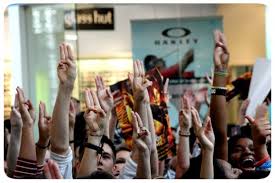
Cult brands do not always take decades to be created though. The Hunger Games has, in less than a decade, progressed from a brand new book series to one of the largest cult followed series in history, making over $1.5 billion on the first three movies alone. Much of this has to do with how recent social media advances have enabled the relationship between brands and fans to explode, significantly depleting the gap between companies and their target audiences. In this context, avid fans like Kaylee are able to track the movement in production of the films and follow the lives of the celebrities that participate in the movie in greater detail, and are then encouraged to share this information with their friends, thus working as unpaid marketers for all things Hunger Games. In this relatively recent change to the marketing industry, the lines between the threefold relationships of community, "community member to brand, community member to firm, and community members to each other", have blurred, allowing all three to happen in the reading of a tweet online and re-tweeting it to fellow Hunger Games community members (Einstein, 89).

This marketing change has significantly expedited the process of making brands into brand cults, while ensuring that the focus on community, meaning, and identity remain. They have transformed the art of marketing into a religious process focus on bringing community together in an identifiable way; Christianity has its services and blessings, Harley has its "Harley wave" and rallies, and The Hunger Games has its three-fingered greeting and four-toned whistle.

Other resources:
http://www.pbs.org/wgbh/pages/frontline/generation-like/
http://www.harley-davidson.com/content/h-d/en_US/home/museum.html

The New Age of Company Branding

       In the Frontline Documentary "Generation Like," the film discusses a new type of way for companies to "brand" their products. As said by Mara Einstein, branding is an attempt by companies to "create loyalty among its customers."(p.71) The ultimate goal of branding products is so the brand "becomes part of popular culture." (p.71) In the past, the branding of products had to be done by the companies through commercials, billboards, and other means of trying of show their product to the masses. The rise of "generation like" has shifted more of the responsibility of spreading the brand to the consumer. In today's Internet, the consumer spreads the brand's message through the use of "likes" and "sharing." In the documentary, a film called "The Hunger Games" used unpaid social media users to spread the message about the upcoming movie. This new way of advertising brands works because people trust other people more than companies and having your friends endorse a product makes you more likely to buy that product (as well as tell your other friends about it).


       Another central goal of branding is to creating a specific identity. People choose specific brands to create their own identity. These brands define us in society (and we want them to define us). The brands a person wears tells us about their wealth, family, religion, and many other things. Today, it is one of the central ways we define people. Social media has allowed us to expand how we identify ourselves. We create an online identity by "liking" and "sharing" brands online. One's "likes" are identified for all to see, and is a prime way companies target specific customers. "Liking" an Oreo with gay pride colors as the center combines the use of social media and brands to define us. Branding and the use of social media compliment each other, as both try to put people inside a community of like-minded people, hopefully creating a long-lasting following for both the brand and for the person. 

Thursday, October 9, 2014

The Hunger Games: A Step Beyond Apocalypse


Apocalyptic movies have been a important genre of film since the beginning of modern cinema and highlight the human fascination with our own destruction and the repercussions of it. In Dan Archer’s comic he describes apocalypse as myth that provides a “unifying ‘do good’ feel." As seen in movies like World War Z, Apocalypse unifies us in protection of humanity. Destruction causes people to give and work towards survival without bias and hatred. In World War Z, Brad Pitt's character and his family take refuge inside of the apartment of a immigrant family. Despite their differences and language barriers, both parties work cooperatively to survive. Countless examples like this arise is every apocalyptic movie from Apocalypse Now to World War Z. Despite the varying changes that may come to apocalyptic movies, humans always survive. Despite the conscious fear of our own impending destruction, humans always find a way to survive as a species. This facet of the "end of days" narrative has always exemplified a true hope in humanity. As Elaine Pagels writes, "the Book of Revelation appeals not only to fear and desires for vengeance but also to hope." 

This fascination with hope is shown is the evolution in the apocalyptic genre. Recent movies like The Hunger Games and the City of Ember highlight the post-apocalyptic society. More than simply show the apocalypses and how humanity survives; new movies have highlighted the societal repercussions of survival. The Hunger Games takes place in a nation known as Panem. Panem is established a after the destruction of the continent's civilization by an unknown apocalyptic event. In the aftermath, a state is created in which the capital suppresses the surrounding thirteen districts, resulting is a revolution. The Hunger Games especially, showcases the evils that still may exist after the end of days. Moreover, it fights against the common Christian notion that good permanently triumphs after the Armageddon. While, our conception of apocalypse will remain the same, it is interesting to see how that fascination has evolved into post-cataclysmic fear.