Showing posts with label Community. Show all posts

Thursday, December 11, 2014

Cult Branding: A cultivated Effort

How do American brands effectively market themselves in ways that make them "brand cults"?

Just as all religions need followers in order to survive and thus market themselves to gain them, non-religious organizations also seek to "sell 'community, meaning and identity'" in order to become one of the elite brand cults in America (Einstein, 91). Community, meaning, and identity do not  occur naturally though, they need to be carefully cultivated, nourished, and legitimized. To do so, companies market themselves to niche groups, promising the "rituals, traditions, and a shared worldview" that people of all walks of life inherently seek (Einstein, 91).

Take Harley Davidson, when it started over 100 years ago, it did not have a cult following, a ritualistic hand signal between drivers, or a large celebrity backing. It was simply a brand with a new concept of how to get around on a bike with an engine. Through its marketing strategy, it became one of the main military tools in WWI and WWII, building a cultural identity for itself of reliance, dependability, and American freedom. Then it became the bike of Elvis, furthering both its traditions of excellence and rebellion, and enlarging and legitimatizing the community of Harley drivers. Now, it is the motorcycle company of America. It is a "religious icon" and it is a brand cult (Einstein, 91)
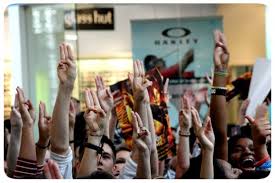
Cult brands do not always take decades to be created though. The Hunger Games has, in less than a decade, progressed from a brand new book series to one of the largest cult followed series in history, making over $1.5 billion on the first three movies alone. Much of this has to do with how recent social media advances have enabled the relationship between brands and fans to explode, significantly depleting the gap between companies and their target audiences. In this context, avid fans like Kaylee are able to track the movement in production of the films and follow the lives of the celebrities that participate in the movie in greater detail, and are then encouraged to share this information with their friends, thus working as unpaid marketers for all things Hunger Games. In this relatively recent change to the marketing industry, the lines between the threefold relationships of community, "community member to brand, community member to firm, and community members to each other", have blurred, allowing all three to happen in the reading of a tweet online and re-tweeting it to fellow Hunger Games community members (Einstein, 89).

This marketing change has significantly expedited the process of making brands into brand cults, while ensuring that the focus on community, meaning, and identity remain. They have transformed the art of marketing into a religious process focus on bringing community together in an identifiable way; Christianity has its services and blessings, Harley has its "Harley wave" and rallies, and The Hunger Games has its three-fingered greeting and four-toned whistle.

Other resources:
http://www.pbs.org/wgbh/pages/frontline/generation-like/
http://www.harley-davidson.com/content/h-d/en_US/home/museum.html

Thursday, November 13, 2014

Religion, Rituals & Music: Quite an Af"fair"

You may have heard of a musical routine, but have you ever heard of a music ritual? Both seem to mean a similar thing. When something is routine, you do it over and over again. Rituals, as one author puts it, are found in every human community; the word rite derives from a Greek word meaning “a thing done” to achieve a specific end (Livingstone 98.) Yet how can a music be something so liberating, and also be a ritual, when you follow certain guidelines?
Although it may not be as clear-cut as that, (liberating vs. guidelines), there’s an interplay here between liberty and constraint, ritual and improvisation, inherent in musical performances. 

It’s almost undeniable that music is a powerful thing. David Laderman writes that for many people, the physical and visual/sensory stimulations found in the music scene create a “sacred mix that has the power to transform identity, offer revelations, and provide liberation.” Bodily movement and proximity to others are found at music festivals, and religious gatherings. Is circling around the Kaaba in Mecca completely different than circling in a mosh pit at a metal concert? Yes, they do have many differences. But they both use certain patterns of movement to achieve an out-of-the-ordinary sensation, and a sense of community.

Many have said they have a “spiritual experience” at  concert – but what do they mean by that? If we look at religious ritual, which can be defined as “an agreed-on and formalized pattern of ceremonial movements and verbal expressions carried out in a sacred context” (Livingstone 98), then we can see that the “sacred” is a key part in this experience. What is the sacred? Deriving from Greek, it means to something set apart, away from the mundane. And when do you ordinarily “sing and dance and groove with others ” in public, other than at a music event (Laderman 32)? Or other than at church or a religious space? There is a specialness and sacredness in the newness, proximity to others, and routine that music and strictly religious rituals facilitate.
Where did I see this ritual the most? At the New York Sate Fair. It seems like an unexpected place to find the sacred: I doubt many see the divine among corndog and fried Oreo stands. But music and rituals were everywhere. I turned one corner, and there’s a Iroquois Village. I sat and watched people from numerous different tribes sing, play traditional drums, and dance the Shadow Dance. This was different than the carnival ride; it was sacred. I could tell this was a mix of music and ritual: I knew when to sit and applaud, and they knew when to dance, turn, even in improvisation. It was without a doubt that this music had a large tie to their heritage, while creating a sense of liberation from their everyday lives and community.

As I continued walking along the signs for ice cream and a barn full of prized sheep, I also saw another example of how religion influences the style of music. I heard a powerful Gospel band preaching and praising the Lord, and hands were raised, Amens were said, heads nodded along.
But after the sun slipped over the horizon, I made way for my religious ritual. I entered a closed off area: a space set apart and scared from the rest. We all huddled and faced the front, knew when to sit for the ballads, and stood up and jumped for the techno hits. I thought of the women shouting for Jesus at the Gospel concert earlier, and I and hundreds of people shouted our praise for Young the Giant. I wore a creamy fringe top and a flower in my hair: a costume out of the ordinary for me, but strangely liberating. I could be a part of a community of flower children, seeing a free concert and rebelling against consumeristic people in their 40s – we were enclosed in our special arena of good harmonies and smiling faces.

One Associated Press story said that the experience of (crunk) music is “reminiscent of a religious experience” (Laderman 38). I’d argue that it’s a deeply ingrained religious experience rather than just a lingering feeling. Music involves a type of spontaneity because you never quite know what the set list is, or who will be standing in your row, but you’re bound to belong, and know when to sway and sing along. I saw at the State Fair that  some musical rituals are easier to spot than other, but I think religious rituals are aspects of many “life-changing” and liberating musical performances.   

Believers of the Sound

Individuals often seek activities that bring them comfort and explanation for moral dilemmas; music/sound, in similar ways to religion, has served that purpose for centuries. Oral presentation of sacred teachings has occurred since the formation of religion, as the original method for teaching. As such, the presentation of stories or values through music is a very appealing emotional experience. At concerts, we are not only doused in the physical nature of the music and lyrics, but we are surrounded by a community of individuals who have similar thoughts, bearing a striking resemblance to the religious service experience. Matthew Moore's article Take Me to Church: The Religious Experience of a Concert, illustrates the "[power] about singing songs together as a community," through the "emotions that wash over you when you hear a room full of people singing the words of your favorite song together." 
There was a stark difference between my first concert experience (a rave) and my most recent concert, Jake Bugg, one of my favorite artists. The former was a surreal experience, mixed with confusion and jam-packed energy, but alongside many friends. The latter, on the other hand, was more calm and formal, where I only knew one other person in the room. Ironically, I felt more comfort at the latter where I was able to engage with the artist as soon as he began to sing. I felt part of a greater community with strangers singing in passionate unison, than in the presence of a large group of friends. 
I can only equate the feeling to reciting the "Our Father" during mass. While I have not been to mass in a very long time, I can very tangibly recall the overwhelming emotion that would come over me as I recited the prayer alongside a room full of fellow believers. In this way, sound and/or music transcends past the individual and simultaneously strikes a chord with a larger community. 

Wednesday, October 8, 2014

A Story of Hope in Ambiguity

Apocalyptic literature has much to say about the fundamental nature of humans. Previous to technology and modern inventions, individuals relied on a community and very communal way of life: chores were assigned to various members of a family necessary to human existence. Today, we're very detached from origin of our food and clothing, these things are made readily available. Thus, inhabitants of the modern age have developed very individualized lifestyles, independent of the need to band together with others to survive.

In this way, the stories of destruction described by apocalyptic literature, are often sought out for the larger message they convey: the ability for lone survivors after the chaos to find hope and community in one another, an idea that has been lost to a certain extent through our existing media-heavy culture. In Elaine Pagels' article What Revelation Reveals, she acknowledges John's experience in the Book of Revelation as "[his] worst of all nightmares [ending] not in terror but in a glorious new world," accurately depicting the intended purpose of this literature. In TV shows like The Walking Dead, the plot focus is not on the destruction of society, but on the connections that arise from the darkness, and the light in new life that is formed from this small community of survivors.

The myths of apocalypse enable individuals, whether through religion or pop culture, to have hope in the very ambiguous perceptions of "the end of the world."

Wednesday, September 10, 2014

What Makes a Religion "Legitimate?"

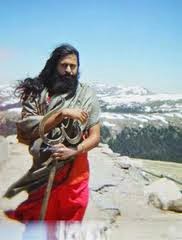
             While discussing the film Kumaré, our class explored the ways in which a religion becomes “legitimate.” We designated religious symbols, the leader’s physical appearance, a sizable following, and several other elements as legitimizing factors. Similarly, after our viewing of Seinfeld’s Festivus” episode, we discussed how the aluminum pole and the airing of grievances seem to “make the festival real.” While all of these elements exist within legitimate, authentic religious institutions, they do not directly designate “legitimacy” or “authenticity.” I find that legitimacy has two sides: the ability to be recognized and the ability to perform. The elements we designated as “legitimizing” are all visual stimuli through which a religion can be recognized; they imply a religion’s successful performance, but do not, themselves, perform religious work. Authenticity does not pertain to a religion’s symbols or rituals or number of followers, but instead refers to the system’s ability to provide an individual with what mankind searches for in religion; a sense of community, identity, and purpose. Kumaré’s staff and the airing of grievances do not inspire a sense of community or belonging, but rather represent the values and beliefs that satisfy an individual’s religious cravings. Thus, legitimacy lies in the combination of the tangible and sensational elements of religion and the successful impact on an individual that these elements represent.