Showing posts with label Kumaré. Show all posts

Thursday, September 11, 2014

What Does It Take To Have An "Authentic" Religion?


What does it take to have an "authentic" religion? In Kumare, Vikram Ghandi tries to explore this question by creating a "fake" religion to see whether people would actually follow it or not. To much of his surprise, the experiment worked as Kumare got at least 14 followers as the movie progressed. In the end, Kumare's teachings and practices were so powerful that even after the truth came out, ten people still stayed loyal to him.

So how did Kumare's "fake" religion become "authentic"? First of all, Ghandi created a series of myths (about his identity and origins), rituals ("the blue light"), and symbols (the staff) that formed the basis of his teachings. Originally "fake" and meaningless, these elements become "authentic" and meaningful as the practice of Kumare's teachings evolves into a transcending experience for the followers. The teachings are "fake" at first but turn to be "authentic" because they answer the people's needs and guide them through their lives. By becoming an experience rather than an experiment, Kumare's religion becomes "authentic" as well since it represents a way of life rather than a simple routine. Therefore, a religion is authentic as long as it is a guiding experience, based on certain myths, rituals and symbols, that creates a meaningful environment for its followers.

A Festivus for the Rest of Us: Do Fake Religions Count?


"Faith begins as an experiment and ends as an experience." 

-William Ralph Inge


A staff, a pole, blue light yoga, and an airing of grievances. Combine these together and you get a fake guru, Kumaré, who created his own spiritual following as an experiment to disprove the importance of religious figures, and a father, Frank, who created his own "Festivus" because had had enough of Christmas. Two very inauthentic movements that took fake traditions and symbols and gave them real meaning for real people.  


At what point do these made-up belief systems move from the realm of cultish groups and quirky family traditions to the ranks of mainline religions? In order to achieve true religious authenticity and authority, do they simply need to gain more followers, create more symbols and traditions, and worship a higher power, or does any of that matter at all? 
 

The purpose of a religion isn’t simply to put faith in a higher power and feel something move within, even though that is important and happens within most religions, it is to give a community of people something to believe in and experience together. Even a fake religion can do that. 

Fake is not a bad word

Is there authenticity in things that are fake and fake aspects of authenticity?  

Who is to say what is and isn't authentic? 

The question of authenticity is very subjective in my opinion. Vikram Gandhi's documentary film Kumaré explores that these two seemingly polar opposite concepts have a strong interplay that is very present in religion today. In some ways, the guru Kumaré can be perceived as a fake and in many ways he was. But the aspects of authenticity that developed from the fake parts of his journey overpowered any doubt that what he was doing was anything but pure.  There was authenticity in the minds of Kumaré's disciples that ended up creating a reciprocated authenticity for Vikram.  His disciples found support in him and in the other students.  The result of Vikram's experiment showed that "fakeness" can breed authenticity and that the outcome is just as important as the intentions.  


I come from a practicing Christian family. When I'm home, we each go to church at least twice a week.  Yet, when faced with a dilemma, we do not think "What would Jesus do?" Because for us, being a Christian is not about what Jesus did and the fact that he was the Messiah, it is about belonging to a loving community with shared beliefs. Yes, we believe in God, but we go to church solely for the community aspect.  


Does that make us bad Christians? 

Does that make us fake Christians? 

Of course not. 


In his book, Authentic Fakes, David Chidester states that "religious activity is at work in forming community, focusing desire, and facilitating exchange" (5). A church, temple, synagogue, or religious doctrine does not make a religion authentic, and a lack thereof does not make a religion fake.  An authentic religion is made by shared beliefs, faith (not necessarily in some deity or idol), and love. Kumaré created an authentic religion through spreading love with people who believed in what he was teaching about finding a guru within yourself.  His fake intentions do not matter because the outcome was so pure. The same goes for me and my family; the "fakeness" of our intentions does not make the outcome of the love we share and happiness we receive any less authentic. 


Authentic v. Fake: If the connection is real, does it matter?


David Chidester's Authentic Fakes considers that "even fake religions can be doing a kind of symbolic, cultural, and religious work that is real." (9) The key word in this idea being real. Religion ultimately involves real connections, real advice, and real experiences woven into an identity larger than oneself. 

As demonstrated through Vikram Gandhi's documentary Kumaré, a completely fabricated religion filled with seemingly meaningless rituals, like the yoga movements, was able to very intimately connect with different people. Sure Kumaré's fake costume and props could have facilitated his supporters' trust initially, but ultimately people stick by him at the end of the film because he was a real companion. His kind of teaching encouraged peoples' beliefs in themselves, and as such they could trust him in the end because he did not claim to be a prophet or other godly-figure; he merely acts as an enabler for individuals faith in their own powers and abilities.

Similarly, the celebration of the fabricated holiday, Festivus in Seinfeld, encompasses very real and honest dialogue. Through the "feats of strength" and "airing of grievances", very truthful communication can take place. Although the holiday observance evokes humor on the show, its purpose is to acknowledge real experiences, good or bad, and to celebrate life in its entirety.
Although these are two fabricated religious experiences, they honor real experiences and interactions and allow people to connect and grow. If someone benefits from these religions, does it matter if they were fake originally?

Wednesday, September 10, 2014

Creating Authenticity


        Why do individuals need an authentic source? Why must we have a real guru or supernatural force to legitimize our faith? In the film Kumaré, Kumaré’s followers were willing to listen to him because he seemed to be a real guru. However, as the film progressed, Kumaré provided the same amount of help and peace that one derives from a “real” religion. In a sense, the film demonstrated that authenticity is not necessary to give people what they need. This sentiment was echoed throughout the readings this week. If the power to attain inner peace has been ours along, then why do we need an authentic source to act as a conduit for us? Where does the need for authenticity come from? Why do we need the son of God or a mystical guru to help us? If Kumaré had presented himself as an average man, would anyone have listened to him? Probably not. Perhaps we crave this authenticity because the guidelines that we adopt from religion are so consuming. As Martyn Oliver argued in “10 Things Every College Student Needs to Know About Religion”, ritual can be more important than belief. So, if one is going to so strongly adopt a code to live by or if said code is already integral to their identity than it has to be extremely significant. If it is going to take or already holds such a prestigious position in one’s life, then it has to have a fair amount of meaning. Meaning that powerful can be found in an “authentic” source like God or an Indian guru. Their “realness” elevates the status of one’s belief and perhaps provides a sense of affirmation for its adoption. 


What Makes a Religion "Legitimate?"

             While discussing the film Kumaré, our class explored the ways in which a religion becomes “legitimate.” We designated religious symbols, the leader’s physical appearance, a sizable following, and several other elements as legitimizing factors. Similarly, after our viewing of Seinfeld’s Festivus” episode, we discussed how the aluminum pole and the airing of grievances seem to “make the festival real.” While all of these elements exist within legitimate, authentic religious institutions, they do not directly designate “legitimacy” or “authenticity.” I find that legitimacy has two sides: the ability to be recognized and the ability to perform. The elements we designated as “legitimizing” are all visual stimuli through which a religion can be recognized; they imply a religion’s successful performance, but do not, themselves, perform religious work. Authenticity does not pertain to a religion’s symbols or rituals or number of followers, but instead refers to the system’s ability to provide an individual with what mankind searches for in religion; a sense of community, identity, and purpose. Kumaré’s staff and the airing of grievances do not inspire a sense of community or belonging, but rather represent the values and beliefs that satisfy an individual’s religious cravings. Thus, legitimacy lies in the combination of the tangible and sensational elements of religion and the successful impact on an individual that these elements represent.

Fakeness vs. Authenticity in Religion


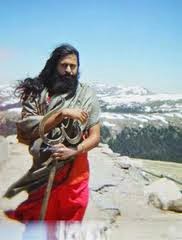
David Chidester wrote in his book Authentic Fakes, “even fake religions can be doing a kind of symbolic, cultural, and religious work that is real,” (Introduction, 9). This quote captures the central theme of our discussions this week, fakeness versus authenticity. In the film Kumaré, Vikram Gandhi literally makes a fake religion, yet he obtains a following so strong that he changes peoples’ lives. But what really is it about Kumaré that people got so attached to? First of all, there are physical aspects of Kumaré that made him seem authentic (as seen in the photo below), such as his hair, clothes, beard, and even his props (necklace and walking stick). He even created fake chants and yoga moves. However, what made his “religion” real weren’t the physical aspects, but the beliefs he taught. His teachings include that all people have a guru and happiness inside. Kumaré was able to help his followers with real problems, such as marriage issues, weight loss troubles, and even career problems. The help that he provided these people was completely authentic even though the physical aspects of the religion were fake. It is obvious after this week that fakeness and authenticity come hand in hand. There are fake aspects of every religion. Christianity is as real as a religion can get, however, aspects like Santa Claus and Christmas trees are unauthentic. Even though Christmas is related to these fake aspects, the meaning of Christmas is completely real. Kumaré, as well as Christmas both prove that you cannot have authenticity without fakeness in a religion and vice versa.